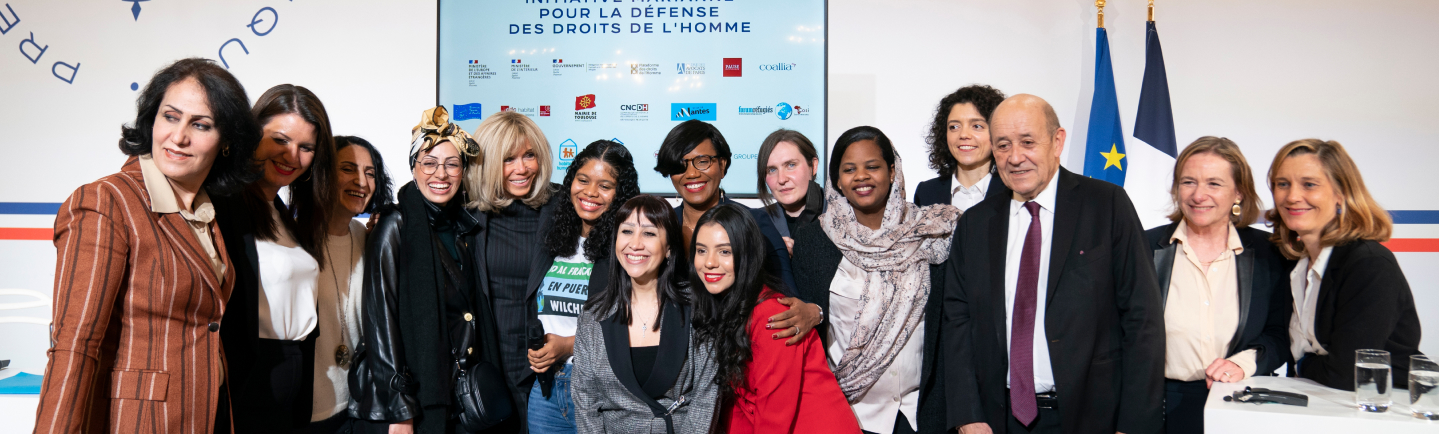
The laureates

Description
In 2008, Roshna Khalid became the first female presenter for national television throughout northern Afghanistan. At the same time, she was appointed director of the Institute of Technical and Professional Education in her province and was spokesperson for the provincial governor’s office, responsible for social affairs, positions she held until 2021. Committed to equality between women and men, she founded a radio station dedicated to women’s rights, particularly education and media representation. Threatened several times for her activities by the Taliban, she is forced to go into exile in France in 2021.
Interview Roshna Khalid – July 26th 2024
Can you please introduce yourself?
My name is Roshna and I am an Afghan journalist. Today, I am a refugee in France, in Périgueux, where I continue to pursue my activism commitments.
Can you describe your commitment as a human rights defender?
I have always been dedicated to defending human rights, especially those of women and children. Recently, I founded the Roshna Association, which raises awareness about living conditions in Afghanistan. Currently, my ambition is to amplify the impact of my actions by creating an online community capable of reaching a wider audience. However, the language barrier remains a challenge that I am trying to overcome.
Why did you decide to advocate for human rights?
The situation of women in Afghanistan is dramatic: they are deprived of their rights and freedoms and silenced. Faced with these injustices, I could not remain indifferent. I decided to commit myself to carrying their voice and actively fight so that their rights can be recognized and respected.
Why did you want to participate in the Marianne Initiative?
When the Taliban returned to power in August 2021, I had to flee Afghanistan. I lost my job and my country. The Marianne Initiative has allowed me to regain my motivation, rebuild myself and resume my fight. This program has given me the opportunity to acquire new skills, learn and broaden my horizons.
What were the most enriching programme activities?
All the training sessions were beneficial for me, but I am particularly impressed by the one on Negotiation and Leadership at Sciences Po. In addition, the meetings with organizations such as Reporters Without Borders were extremely enriching and motivating for my commitment.
What did you do once the program was finished?
Following the program, I found inspiration and strength to create my own association. A year later, the Roshna Association became a reality. It allows me today to realize my projects and continue to defend the fundamental rights of women and children.
What are your plans for the future?
In the short term, I want to move to be closer to Paris, because the distance from Périgueux limits my access to certain professional opportunities. For now, I am focusing my efforts on the activities of my association. I have already organized several cultural events, including concerts, performances highlighting Afghan culture, and celebrations such as International Women’s Day. These initiatives aim to raise local awareness of the richness of Afghan culture and to defend women’s rights.
I managed to establish myself locally thanks to Radio Libre Périgord and the support of the municipality, and this encourages me to continue my work with even more determination.